

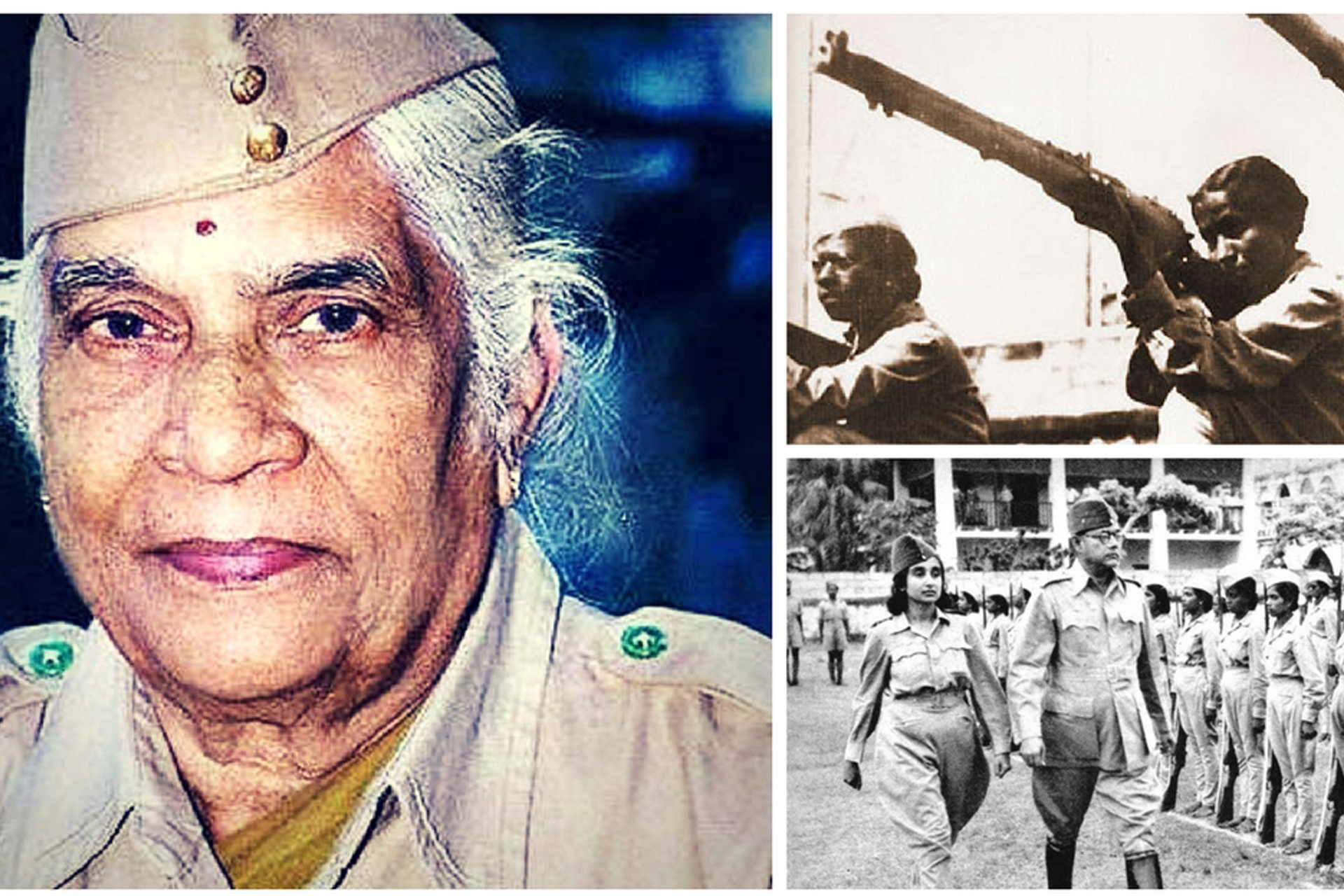
Mani was a Boy and Rajamani Saraswati a woman, who gave away everything that was hers, for Indian’s freedom— Including her identity
“She is going to shoot the British when she grow up” was her reply to Mahatma Gandhi, when he met a barely ten year old Saraswati Rajamani with a gun in her parental home in Burma (Myanmar). The cause of Indian independence was the one that drove Saraswati Rajamani to become India’s youngest spy. She was born into the family of freedom fighters. Her father was a rich miner from Trichy, committed towards freeing India from the colonial clutches.
Rajamani was born with a silver spoon but instead of living a life that was full of comfort and luxury, Rajamani wanted to help India get freedom and she strove towards it from the start. Rajamani respected Mahatama Gandhi but she believed in more vehement ways and wanted the British out from her land quickly. As she grew up she knew her ambition and it could be channelled by Netaji Subash Chandra Bose’s Indian National Army. She did not place her conviction on constitutional procedures, law and order system that the English were cultivating on Indian soil. She was young and fierce.
She was just 16 when Bose visited Rangoon at the height of World War II to collect funds and recruit volunteers for INA. Unlike Gandhi ji and the Indian National Congress, Bose urged everyone to take up arms to liberate India from British rule. Deeply impressed with his fiery speech, Rajamani removed all her expensive gold and diamond jewellery and donated it to the Indian National Army.
This magnanimous action did not fail to attract the attention of Bose who, on enquiring, found out that Rajamani was the daughter of one of the wealthiest Indians in Rangoon. The very next day, he arrived at Rajamani’s residence to return all the jewellery.
On meeting Rajamani’s father, Bose said, “Due to her innocence, she gave away all her jewellery. So, I have come to return it.”
While her father, a freedom fighter who had himself made massive donations to Bose’s cause, simply smiled in reply, an indignant Rajamani said, “They are not my father’s, they are mine. I gave all of them to you, and I will not take them back”
So stubborn was the teenager that Bose could not but admire her determination. He told her, “Lakshmi (money) comes and goes but not Saraswathi. You have the wisdom of Saraswathi. Hence, I name you Saraswathi.” This was how Rajamani became SaraswathiRajamani from that day onwards.
In the very same meeting, the 16-year-old urged Bose to recruit her in his army. So persuasive was she that the very next day, Bose recruited Rajamani and four of her friends as spies in INA’s intelligence wing.
Disguised as young boys, the girls started working as errand boys at British military camps and officers’ houses. As covert agents behind enemy lines, they were responsible for intercepting government orders and military intelligence from the British officers and handing these over to INA.
Rajamani (as a boy her name was Mani) and her friends masqueraded as boys for almost two years to gather intelligence on British movements. While the unit had been told to avoid getting caught at all costs, one of the girls was once caught by the British. Knowing the consequences of being caught, Rajamani decided that she would try and rescue her fellow spy.
The gutsy teenager dressed herself as a dancing girl, drugged the officers at the prison, and rescued her colleague. As the girls were escaping, they were shot at by the Britishers and Rajamani suffered a bullet wound in her right leg. Still bleeding as she ran, Rajamani and her friend climbed up a tree, where they camped for three days while the British carried out their search operation.
The bullet wound left her with a permanent limp, but Rajamani was proud of it. For her, it was a reminder of her exciting days as an INA spy.
Later, Rajamani would often recall how delighted Netaji was at their brave escape and the proud moment when she was given a medal by the Japanese emperor himself, along with the rank of Lieutenant in INA’s Rani of Jhansi Brigade.
When INA was disbanded after the British won the war, Saraswathi and the other INA members returned to India on Netaji’s instructions.
Saraswathi Rajamani and her family gave away everything they had and made their way to India. Sadly, the family that gave everything they had to the freedom struggle, had to live a life of penury on their return to India.
For a long time, this veteran freedom fighter lived alone in a dilapidated and cramped one-room apartment in Chennai, adorned only by several photographs of Netaji Subhas Chandra Bose. Recently, the Tamil Nadu government allotted her a house, albeit an old one in a housing colony.
Age has hardly faded Rajamani’s spirit and determination to serve her nation. Even at this old age, she visits tailor shops and collects cloth scraps as well as rejected fabrics from them. She uses these materials to make clothes that she then donates to orphanages and old age homes. During the devastating tsunami of 2006, she also donated her meager monthly pension to the relief fund.
Unfortunately our mainstream history texts never include these heroines of the past, it was due to their untold and unheard deeds that constantly dented the authority of the English and ultimately bought us freedom. Saraswati Rajamani exhibited such brave heart when it was the need of the hour, for which she never demanded recognition. It is our failure as a humdrum society that we too fail to acknowledge them.