


It’s time for us to learn once again, to use, reuse and discard without harming our planet.
“ Get the jhola(cloth bag) and come along son, we are going to buy vegetables”, these were usual words of my father when he wanted to go for vegetable, dairy or any other shopping. There was another jhola(cloth bag), if we were going to shop for mutton, poultry or fish and definitely a fresh washed and clean bag for the shopping of puja stuff (flower, fragrance and other material of decoration for worship).
All these bags were identified and hung in the three nail hanger on the right wall of our kitchen, so there was no mistake, yet we had the habit of showing and asking mom about which one was the correct one for the stuff we were going to shop for… and she use to answer yes/no or suggest to take the other one.
How gradually the habits were changed, we stopped carrying our jhola, even for stuffs like milk, curd and cooked food. Finally, we are forced to rethink and rework our habits as from 24th May 2018, Maharashtra has become the 18th state to ban plastic. Stiff penalties have been introduced and violators will even face a jail term. As per this ban, the use of plastic bags, single-use disposable items such as cups, straws, plates, forks, spoons and spreadsheets has been prohibited. Are we aware that Maharashtra state is among the largest generators of plastic waste in the country at 30 per cent.
Those who can recall the routines and habits of 70s and 80s, will surely agree that the mornings then were starting with a duty, generally at 5:00 am for those who were getting fresh milk in their steel container from a milkman and at 6:00 am for those getting bottled milk from Parag milk booth.
In our case, this duty was fixed for my elder sister, who never failed to wake me too, to accompany her with empty milk bottles in a jhola(cloth bag). Splashing our eyes with water, we used to rush as the milk bottles at Babu’s booth use to vanish as soon as they arrived. Babu’s process was simple and unbiased, first give money, then hand over empty bottles, further to which he would give new bottles filled with milk.
As the day passed by mom could ask me or my sister, any time, to run empty handed and get pav kilo (250 gm) curd from Tripathi halwai, the shop located at the end of the street. The curd was given in an earthen pot covered with a piece of paper not in a polythene bag. Even the Sweets were given in a hard sheet box or a dhak leaves container, samosa and namkeen in paper bags, rasgulla in a earthern (handi) pot, local chat was served in leaf based vessels, lassi, chach, tea, hot milk and water was served in earthen pot. There was no use of plastic in the entire process of shopping and consuming.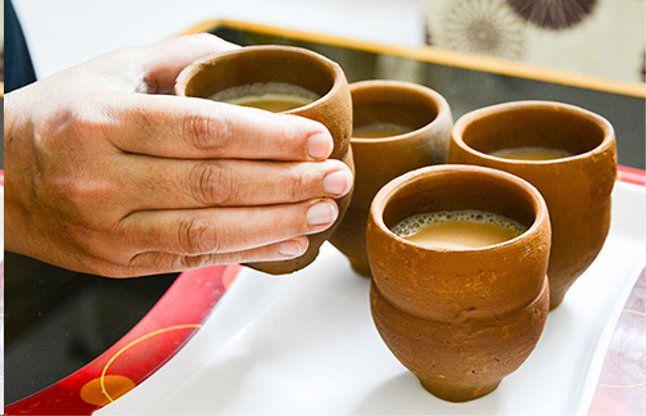
The monthly provisions were never bought on impulses but through a planned process, therefore, bags and sacks were mostly carried along. The grocery shops were measuring and packing pulses, spices, dry fruits and other tit-bits in paper bags, rice and wheat in jute sacks and the entire thing was shifted in our bags or in a big wood-stick basket, which was usually carried by a boy from the shop till home or at least to a rickshaw. These sacks, boxes and baskets were usually preserved at home for next use before letting them perish. The empty milk bottles or even the cold drink bottles were made of glass (lead) not plastic, so they were exchanged with new fillings.
In the worst case scenario, when there was no solution available with the shopkeeper, you would agree, that we used to carry a vessel or a pot to bring home stuff like fresh juice or pani puri syrup from the gol-gappa vendor.
The consumption style was extremely eco-friendly during those days, people were not dependent upon packaged food, packed vegetables and packed cereals but fresh, unpacked local supplies. Things were so different; the local supplier use to be a famous landmark of that area. Every supply/ collection opportunity was creating new friends and the local grocer was not hesitating to supply on credit.
The lifestyle, compulsions and consumer market has not only changed people’s habit by increasing their dependency on packaged items which is mostly the plastic packaging but also their social behavior. However, now this plastic dependency needs to be reduced to the extent that we adapt a zero plastic use policy and take inspiration from the lifestyle of our senior generations. We have no choice but to adhere to the new law which forces stringent penalties including, 3 months jail term and/ or Rs. 5000 to 25,000/- fine.
Maharashtra generates 469,098 tonnes of plastic waste per anum, hope fully this new law will push the society and market to reduce the use of toxic plastic and the burden of toxic waste on our ecosystem. Every such effort would be meaningful to our call to Save Earth and Save Life.